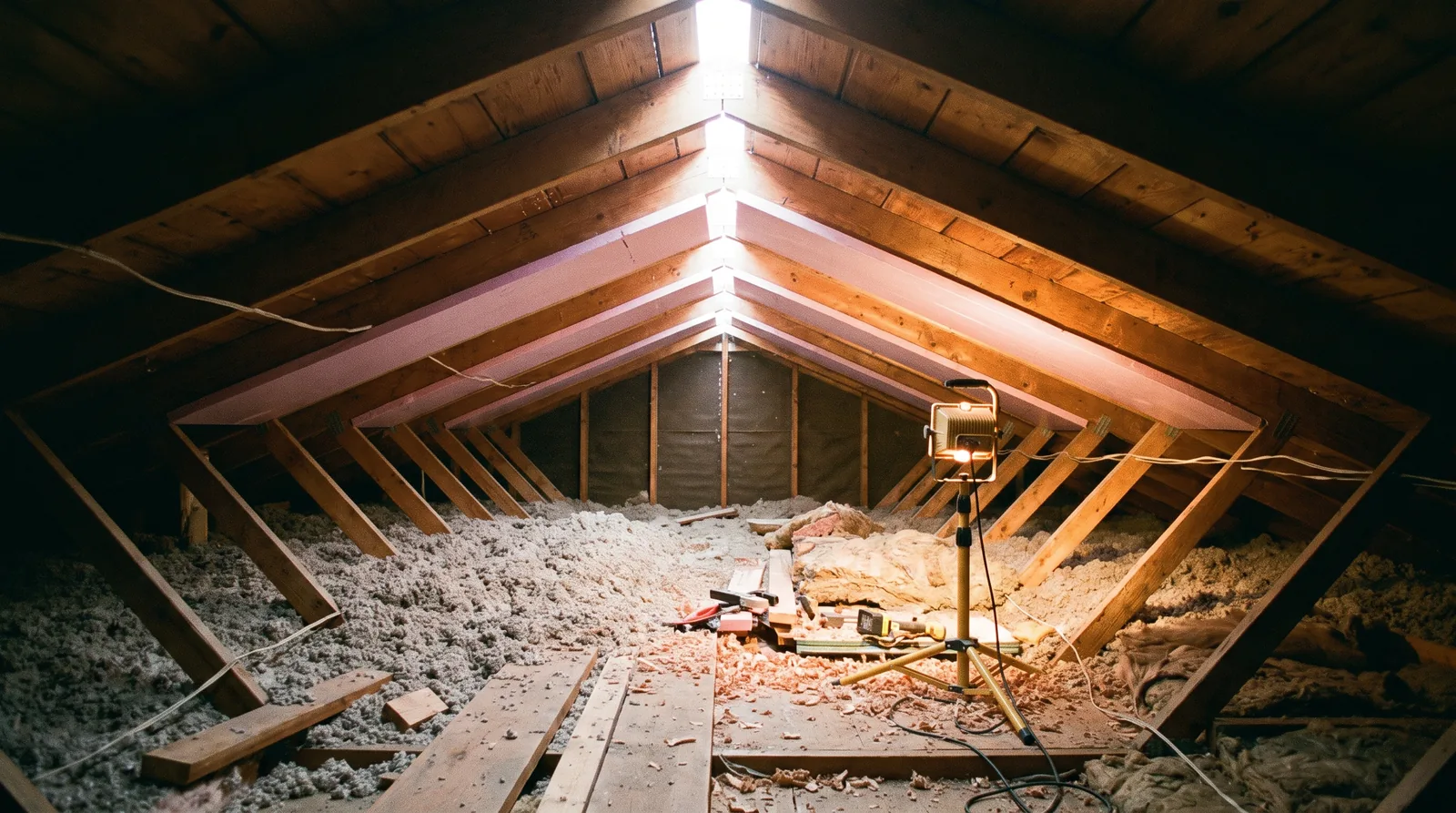
Attic ventilation is the least visible thing on a roof and one of the most consequential. A Johnson County attic with poor airflow runs past 140°F on a July afternoon. That heat bakes the volatile oils out of the shingles from the underside, and they age from the bottom up — a 25-year shingle giving you sixteen. The same failure runs in reverse in winter: trapped warm air keeps the deck above freezing, melts the snow on it, and builds the ice dam at the cold eave.
How it is supposed to work
Air enters low at the soffits, travels up the underside of the deck carrying heat and moisture with it, and leaves high at the ridge. It needs both halves. The code baseline is one square foot of net free vent area for every 150 square feet of attic floor, split roughly evenly between intake and exhaust.
What we do
- Measure it. Attic square footage, existing net free area at intake and exhaust, and where the actual restriction is.
- Open the intake. Perforated soffit panels or continuous vent strip, and rigid baffles at every rafter bay so insulation cannot block the airway again.
- Continuous ridge vent with an external baffle. Externally baffled ridge vent performs far better in wind-driven Kansas rain than the cheap unbaffled kind, which lets water in during exactly the storms that matter.
- Close off what is fighting it. Old box vents left open alongside a new ridge vent short-circuit the airflow — the ridge pulls from the nearest box vent instead of from the soffits. They come out.
- Fix the moisture sources. Bath fans and kitchen fans terminating in the attic instead of through the roof or the wall. We find this in maybe one Olathe attic in five, and it is a major cause of deck mould and winter condensation.
What it is worth
Done with a reroof, proper ventilation adds a few hundred dollars and buys several years of shingle life plus a cooler upstairs. Done on its own it usually runs $900 to $2,400 depending on how much soffit work is involved. It also protects your warranty — most shingle manufacturers require ventilation to their specification, and an inadequately vented attic is one of the standard grounds for denying a premature-failure claim.
Questions we get about this
How do I know if my attic is badly ventilated?
Some quick signs: the upstairs is markedly hotter than the rest of the house in summer, the attic feels like an oven rather than merely warm, there is frost or condensation on the underside of the deck in winter, you get ice dams, or the shingles are curling and losing granules years earlier than they should. From inside, look at whether the soffit bays are blocked by insulation - that alone accounts for a lot of it.
Are powered attic fans a good idea?
Usually not, and we rarely install them. A powered fan moving more air than the intake can supply pulls conditioned air out of your house through ceiling gaps, so you cool the attic by running the air conditioning harder. Properly sized passive ventilation - ridge plus real soffit intake - moves plenty of air with no running cost and nothing to fail.
Can ventilation be fixed without replacing the roof?
Yes. Soffit intake, baffles, sealing bath fan ducts and adding insulation are all attic-side work. Cutting in a continuous ridge vent means working at the ridge, which is straightforward on its own but cheapest bundled with a reroof if one is coming anyway.
Does ventilation really matter for ice dams?
It is half the answer. Ventilation flushes escaped heat out before it can warm the deck and melt the snow. The other half is stopping the heat escaping in the first place - air sealing and insulation. Do both and dams mostly stop forming; do neither and you are managing ice every winter.