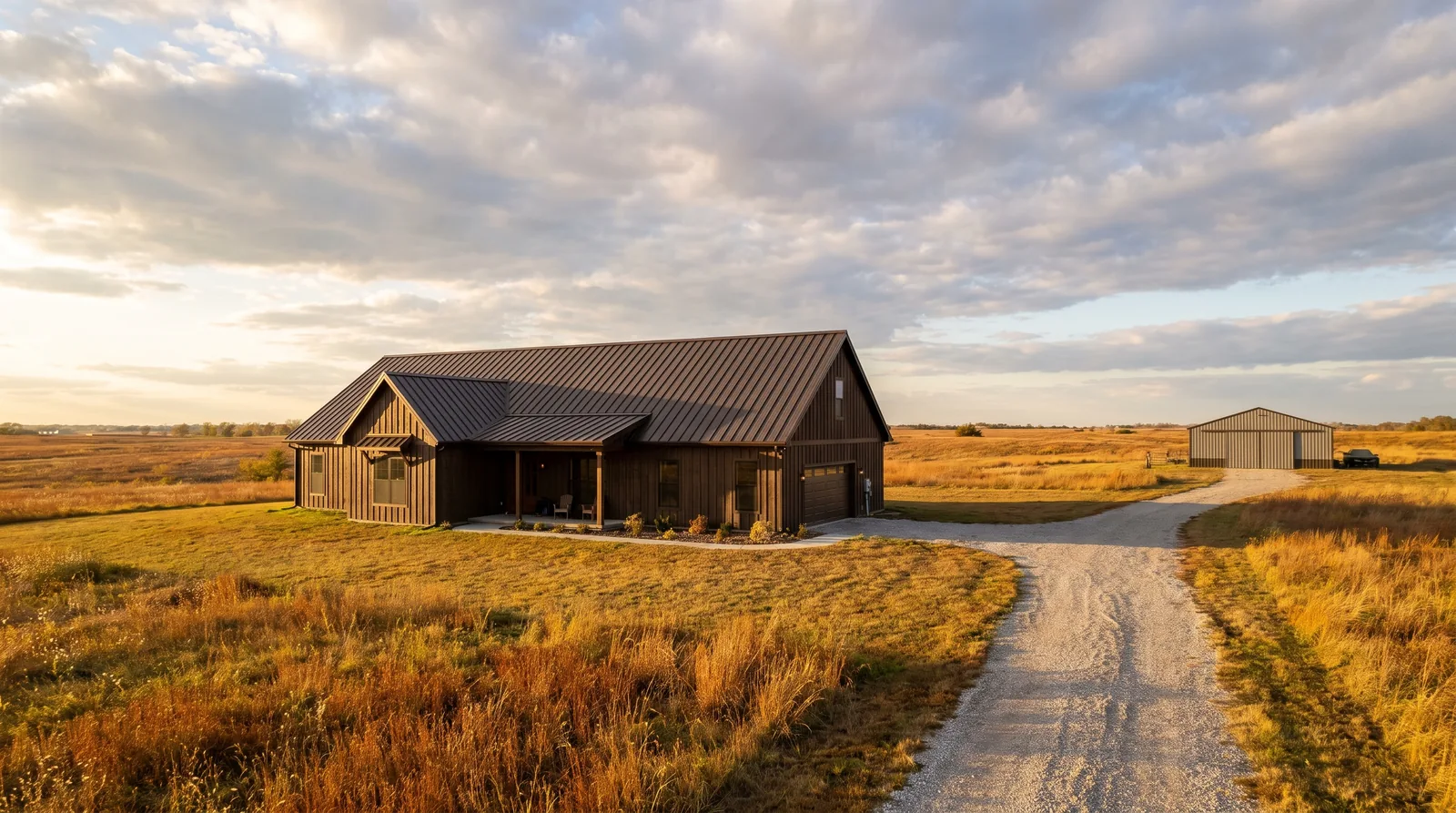
Metal is the longest-lasting roof you can put on a Kansas house, and in a hail market it comes with one honest caveat that most companies selling it will not lead with. We will.
The three kinds worth considering
- Standing seam. Concealed fasteners, panels locked along raised vertical seams. Nothing penetrates the weather surface, which is why it lasts 40 to 60 years. This is the residential product — $28,000 to $48,000 on a typical Olathe home.
- Exposed-fastener panel (R-panel, Ag-panel). Screwed straight through the panel face into the deck or purlins. Far cheaper at $9 to $15 a square foot, and the right answer for a shop, a barn or an outbuilding on the acreage west of Lone Elm and out toward De Soto. The gaskets under the screw heads need replacing every fifteen to twenty years.
- Stone-coated steel. Steel panels with a granulated surface that reads like shingle or tile from the street. Roughly the price of a good Class 4 shingle roof with far longer life, and it satisfies HOAs that will not approve a metal look.
Metal and hail: the honest version
Metal does not crack, split or lose granules, and hail that would total a shingle roof generally leaves a metal roof fully watertight. But hail does dent metal, and a dented panel is cosmetic damage — the roof still works, it just does not look new. This matters enormously in Olathe because many Kansas policies exclude cosmetic damage to metal roofing, or offer the cosmetic coverage only as a paid endorsement.
What we do differently
A metal roof is fabrication, not just installation. Panels cut to length on site so there are no lap seams across the field. Proper clip spacing so the panels can expand and contract through a Kansas year that swings from -10°F to 105°F. Butyl-sealed and mechanically seamed ridges, hips and valleys. And the same ice barrier at the eaves as any other roof — metal sheds snow readily, but the ice-dam physics at an under-ventilated eave do not care what the roof is made of.
Questions we get about this
Is a metal roof loud in the rain?
Not on a house. The noise people remember comes from panels fastened over open purlins on a barn with nothing underneath. On a home the panels sit over a solid deck, underlayment and an insulated attic, and most owners report it is no louder than shingle - a bit of extra sound in heavy rain, which plenty of people like.
Will a metal roof lower my insurance in Kansas?
Sometimes, and less reliably than Class 4 shingles do. Some carriers give a credit for a metal roof's fire and wind resistance; others give nothing, and some will only write it with a cosmetic-damage exclusion. Ask before you commit. In this market, a Class 4 shingle roof frequently produces a better and more certain premium outcome than metal does.
Can you put metal over my existing shingles?
It is physically possible and we generally do not. Going over shingles hides whatever the decking is doing, complicates fastening, and can trap moisture between the layers. On the acreage outbuildings it is sometimes a reasonable call over purlins; on a house we tear off.
How does metal handle the snow and ice we get?
Well, mostly. Snow slides off metal far more readily than off shingle, which prevents a lot of load and a lot of ice-dam formation. The flip side is that it slides all at once, so above a doorway, a walk or a driveway we install snow guards. That is a detail worth planning at design time rather than adding after someone's car gets a roof-load of wet snow.