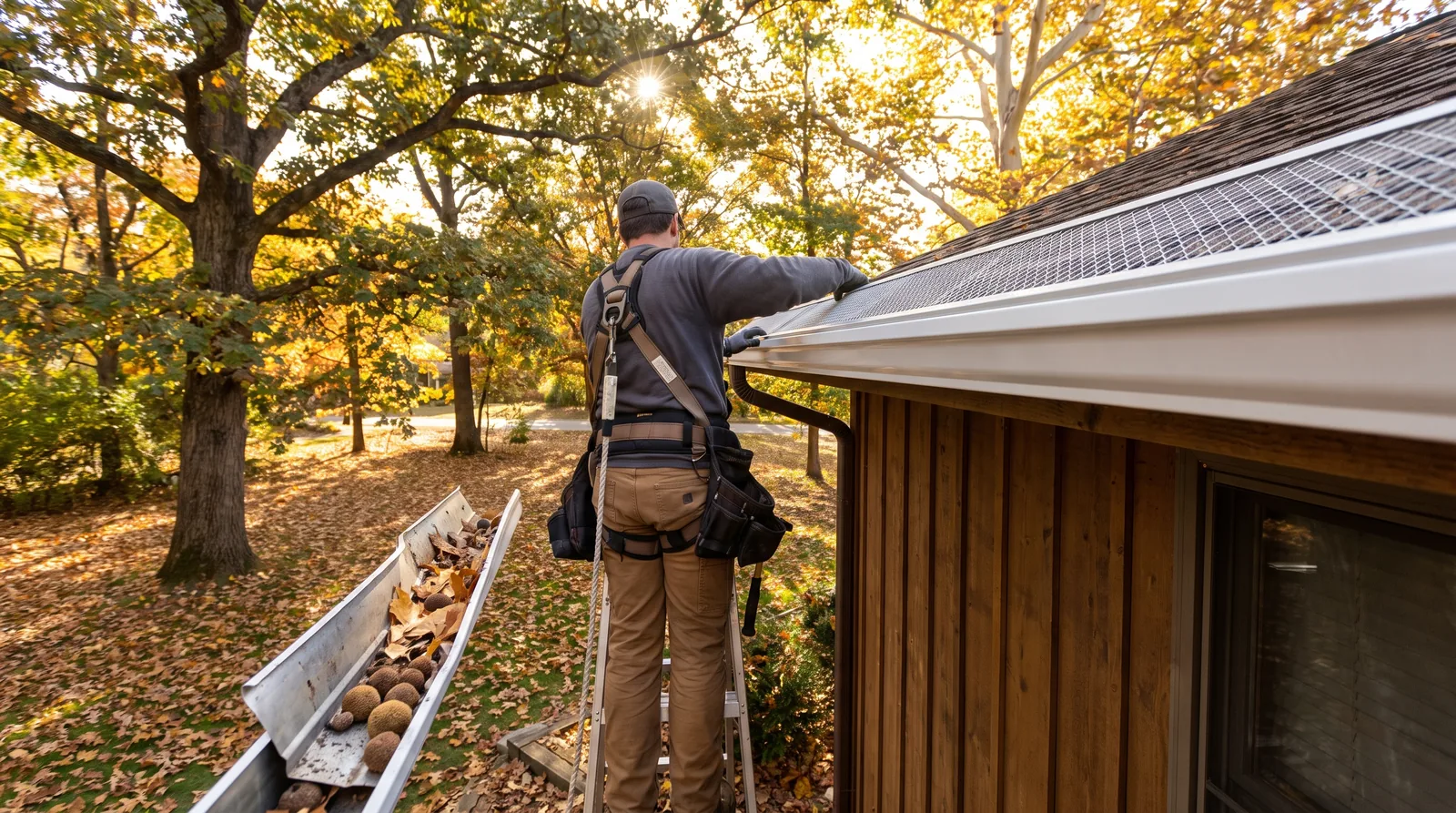
Gutters are the least glamorous part of a roof and the one most directly responsible for what happens to your foundation. Johnson County gets around 40 inches of rain a year and delivers a lot of it in short, violent bursts — the kind where an undersized gutter simply overshoots and dumps the whole roof plane against the foundation wall.
What we install
- Seamless aluminium, rolled on site. One continuous length per run, so the only joints are at corners and outlets — where sectional gutter leaks is at every seam.
- Five-inch or six-inch, chosen by roof area. Six-inch with three-by-four-inch downspouts carries roughly forty percent more water and is the right call for large or steep roof planes, long runs, and any roof that has overshot before.
- Hidden hangers screwed into the fascia every two feet — not spike-and-ferrule, which works loose. Closer spacing where ice load is expected.
- Proper fall. About a quarter-inch of drop for every ten feet toward the outlet. Standing water in a gutter is a hanger or pitch problem, and it is what freezes into a load heavy enough to pull the gutter off in January.
- Downspouts that discharge away from the house — extensions or buried drains, four to six feet minimum. A perfect gutter emptying next to the foundation has achieved nothing.
Guards, honestly
Olathe's older neighbourhoods and the greenbelt lots are full of mature oaks, sycamores and maples, and those roofs fill their gutters every autumn. Micro-mesh guards — stainless mesh over a rigid frame — are the type we install, because they keep out the fine material that defeats everything else: sycamore seed balls, maple samaras, shingle grit, and the oak catkins that drop in spring. Foam inserts and brush inserts collect debris inside themselves and become the problem. Reverse-curve guards shed leaves but overshoot in exactly the heavy downpours that matter here.
No guard is maintenance-free, and anyone who tells you otherwise is selling. Micro-mesh means checking once a year instead of clearing by hand twice a season.
Hail and gutters
Gutters, downspouts, fascia wrap and valley metal are the soft metals an adjuster looks at first, because they show hail plainly when a shingle's damage is arguable. If a storm dented your gutters, that damage belongs in the claim alongside the roof, and gutter replacement is routinely covered where the roof is. We photograph them as part of every hail inspection for exactly that reason.
Questions we get about this
Five-inch or six-inch gutters?
Five-inch handles most Olathe houses. Go to six-inch with three-by-four downspouts where a large or steep roof plane drains into one run, where the run is long, where the roof has overshot in a downpour before, or where a lot of tree litter means you want the extra capacity as margin. The cost difference is modest and it is not something people regret.
Do gutter guards actually work?
Micro-mesh does, within limits - it keeps out the fine debris that clogs gutters and turns twice-a-season clearing into a once-a-year check. Foam and brush inserts trap debris inside themselves and we do not install them. Nothing is maintenance-free, particularly under mature oaks and sycamores.
Can you replace gutters without replacing the roof?
Yes, and it is common. The only detail worth coordinating is the drip edge, which should tuck behind the gutter's back edge - if that is wrong, water wicks behind the gutter and rots the fascia. If your roof is coming up for replacement soon, doing both together is tidier and slightly cheaper.
My gutters are dented from hail. Is that covered?
Usually, where the same storm is a covered loss. Dented soft metals are often the clearest evidence of hail on the property, and carriers regularly include gutters, downspouts and fascia wrap in the scope. We photograph them during the inspection so they are in the claim from the start rather than argued about later.