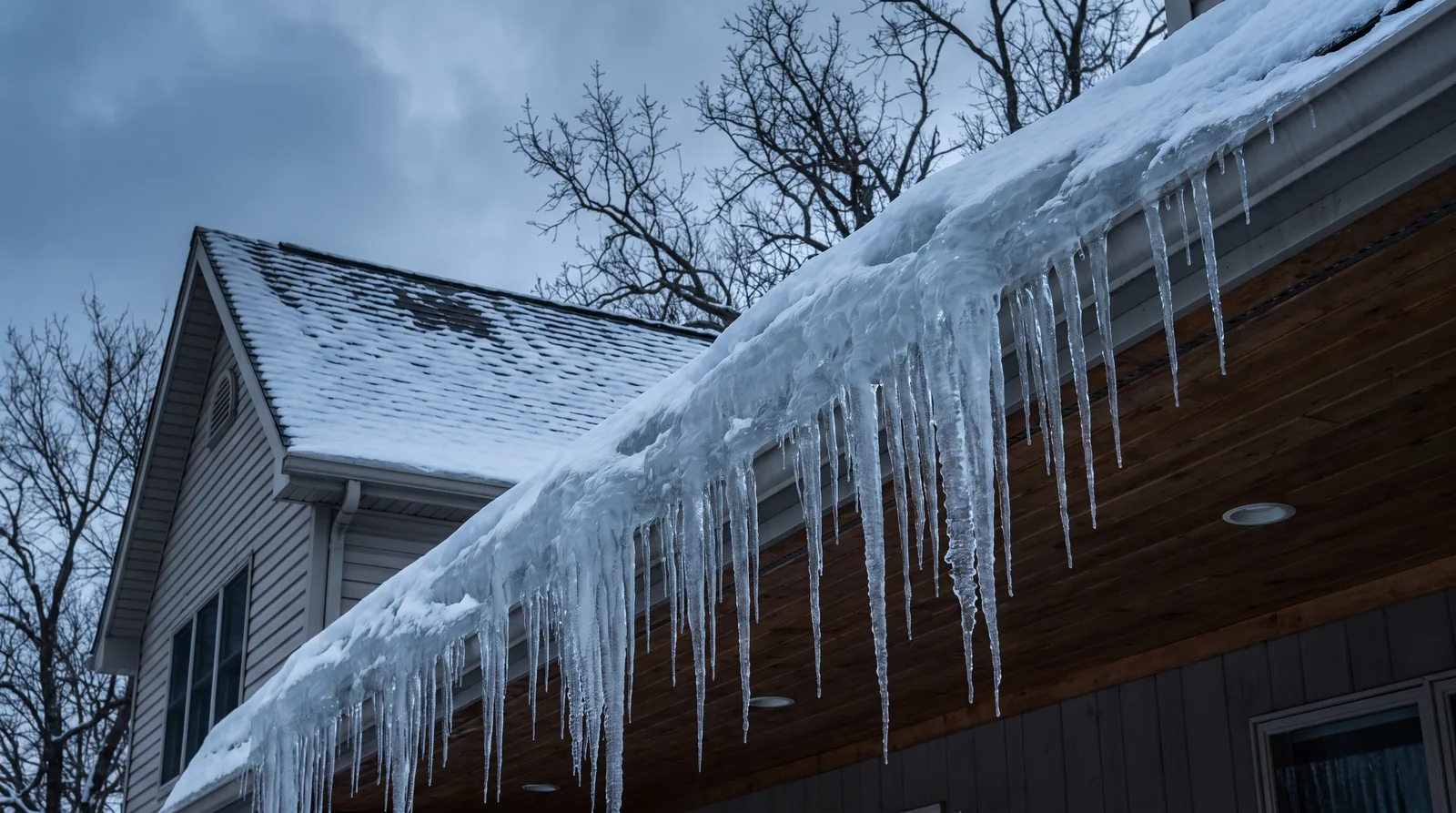
An ice dam is a ridge of ice that builds along the eave and stops meltwater draining off the roof. The water pools behind it, sits there, and then goes the only direction left: sideways and up, under the shingles, through the deck and into the house. It shows up as a stain on an upstairs ceiling or along an exterior wall in January or February, usually on a north-facing slope, and homeowners in Olathe are often told it is a gutter problem. It is not.
Why they form
Heat escaping from the living space warms the underside of the roof deck. Snow on the upper part of the roof melts. The meltwater runs down to the eave — which overhangs unheated space and stays at outside temperature — and refreezes there. Every cycle adds to the dam. What drives the whole thing is a warm roof deck, which means the real causes are inside the attic:
- Insufficient attic insulation, letting living-space heat straight into the attic
- Air leaks — recessed lights, bath fans venting into the attic instead of outside, an open attic hatch, gaps around plumbing stacks and top plates
- Poor ventilation, so what heat does get up there sits against the deck instead of being flushed out by outside air
The code rule Olathe enforces
Because ice damming is a known hazard at this latitude, the 2018 International Residential Code — the edition the City of Olathe enforces — requires an ice barrier at the eaves on new roofs. It must be either two layers of underlayment cemented together or a self-adhering polymer-modified bitumen membrane, and it has to extend from the lowest edge of the roof to a line 24 inches inside the exterior wall line, or 36 inches on steeper pitches.
What we do about it
- Find out whether you have a barrier, and where it stops. From the attic and at the eave.
- Fix the attic first where that is the real cause. Air-seal the leaks, top up insulation, make sure bath and kitchen fans actually terminate outside. A cold, well-sealed attic prevents dams; everything else just manages them.
- Balance the ventilation. Ridge vent with genuine soffit intake and baffles keeping the insulation out of the airway — details here.
- Install ice barrier properly at the next reroof. Full self-adhering membrane from the eave to well past the wall line, in valleys, and around every penetration. On low-pitch roofs and problem north slopes we run it further than code requires.
- Heat cable only as a last resort. It is a management tool for a roof geometry that cannot be fixed — a dead valley, a long low-slope run over an unheatable space — not a substitute for insulation and a barrier.
What not to do
Do not chip at it with an axe or a hammer: you will destroy the shingles underneath and turn a winter leak into a spring reroof. Do not put salt tablets in the gutter — they corrode aluminium and the runoff kills the planting below. If a dam has already formed and water is coming in, a roof rake used from the ground to pull snow off the lower few feet of the roof removes the fuel, and we can steam a channel through the ice without damaging the covering.
Questions we get about this
Are ice dams a gutter problem?
No, though the gutter is where you see the ice. Dams form because the roof deck is warm and the eave is cold, and they will form on a house with no gutters at all. Cleaning gutters is worth doing so meltwater has somewhere to go, but it does not prevent damming. Insulation, air sealing and ventilation do.
My roof is fine in summer and leaks every February. Why?
That is close to a textbook ice dam. Summer rain runs straight off; winter meltwater gets held behind a ridge of ice and forced backwards under the shingles. Roofs are built to shed water flowing downhill, not to be submerged from below, so if there is no ice barrier at the eave it comes through. Seasonal leaks like that are the ones we most often trace to a missing or short membrane.
Can you add ice barrier without replacing the whole roof?
Partially. The membrane is self-adhering and goes directly on the deck under the shingles, so installing it properly means removing the shingles over that section. On a roof that otherwise has life left, we can strip and rebuild just the problem eaves and valleys rather than the whole roof - much cheaper than a full replacement and it solves the actual failure.
Will heat cable fix it?
It will keep a channel open so water can drain, which stops the interior leak. It does not stop the dam forming and it costs electricity every winter. We use it where the geometry genuinely cannot be fixed. If the cause is a warm attic - which it usually is - fixing that is cheaper over any reasonable timeframe and it lowers your heating bill as well.