Olathe is one of the most hail-battered cities in the United States. Radar has detected 193 hail days over it since 2014, and 2026 alone has produced eighteen — including baseball-sized 2¾-inch stones on March 11 and August 6, and tennis-ball 2½-inch hail on April 27 and again on September 6. If your roof has been on the house more than a couple of years, it has been hit. The only real question is how hard.
What hail does to a shingle
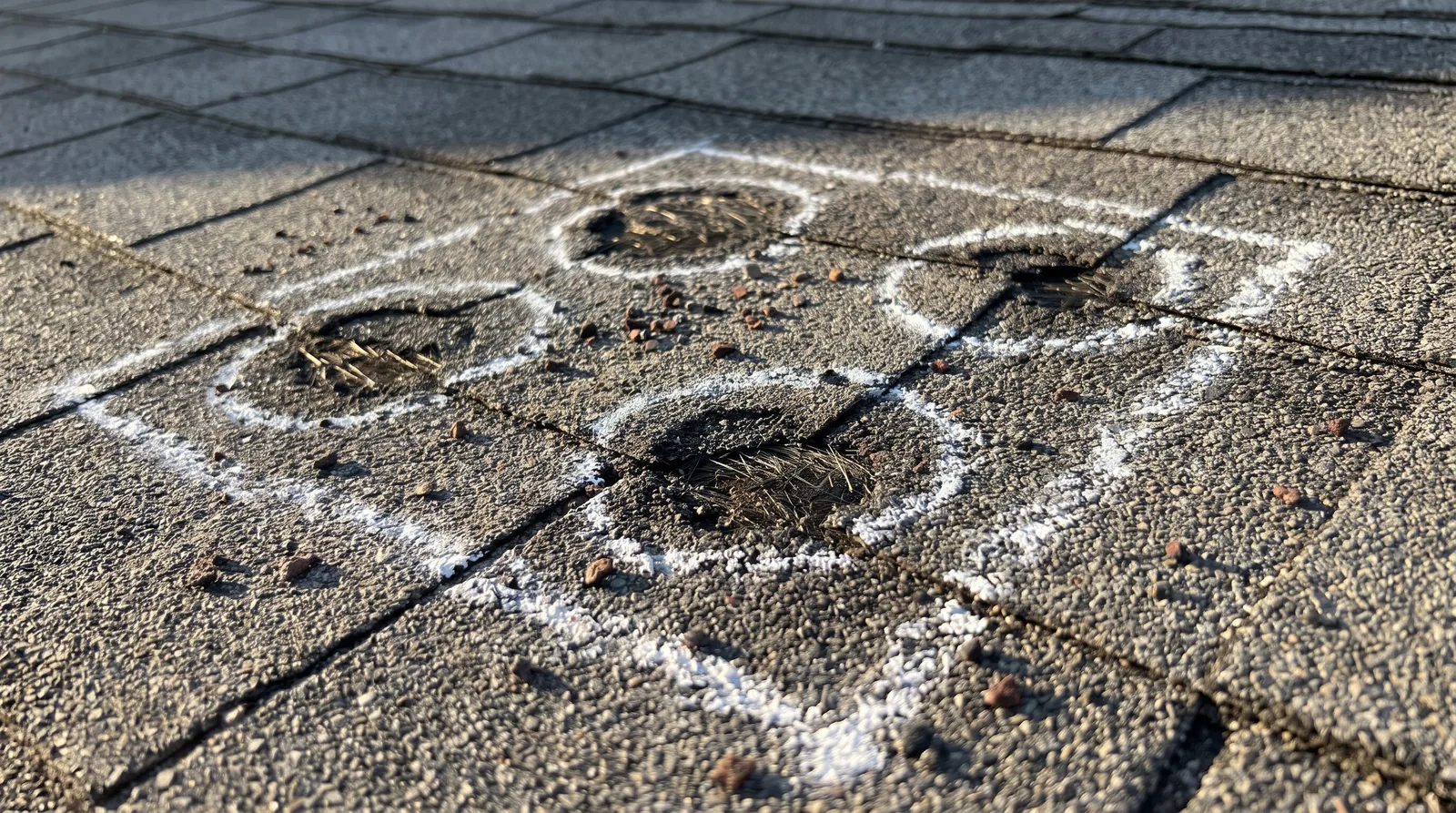
It is not a hole. A hailstone strikes the shingle, crushes the asphalt mat underneath and knocks the protective granules loose in a circle roughly the diameter of the stone. That spot is now bare asphalt with the sun on it. Over the following two or three summers the exposed mat oxidises, cracks, and lets water through — which is why a roof that was "fine" after the storm starts leaking two years later, long after the claim window has closed on that storm.
Roughly, by size: an inch marks up soft metals and starts bruising older shingles. An inch and a half bruises almost any asphalt shingle. At two inches and above, a standard shingle roof is usually a total loss, and the March, April, August and September 2026 storms were all at or above that.
What our inspection actually is
The same thing your insurance adjuster does, done first, so you know what you have before anyone from the carrier is standing on your roof.
- We chalk a ten-by-ten-foot test square on each slope and count the hits inside it — that density is exactly what an adjuster uses to decide a slope is damaged.
- Every hit gets photographed with the square, the slope and the date visible.
- Soft metals get checked, because they tell the truth: gutters, downspouts, fascia wrap, vents, valley metal, the AC condenser fins, even the mailbox. Dented soft metal with an undamaged roof is rare.
- We look at the age and the layer count, because a roof already at the end of its life changes what a claim is worth.
- You get a written, dated report with the storm it matches, whether or not you file anything.
Then what
If there is a claim, we will meet your adjuster on the roof with the photographs and the chalk still on the shingles, and build the job to the scope your carrier approves. If there isn't, you have a dated baseline report for the next storm — which in this city is a matter of weeks, not years. More on how the claim runs, and the full Olathe storm log if you want to work out which storm hit your address.
Questions we get about this
How long do I have to file a hail claim in Kansas?
Most Kansas homeowner policies require notice 'promptly' or within a stated window — frequently one year from the date of loss, though some carriers allow two. The practical problem is different: after enough time passes, the carrier can argue the damage came from a storm outside your policy period or from ordinary wear. That is exactly why we date every report to a specific, verifiable storm. Read your own policy's loss-notice clause, and if a storm crossed your address, get it looked at while the link is obvious.
Will filing a hail claim raise my premium?
Hail is a weather loss, not a liability loss, and carriers generally rate it differently from an at-fault claim. What does move premiums across the whole market is a heavy regional hail year — which Johnson County has had repeatedly, whether or not you personally file. A denied claim, though, is a claim on your record with nothing to show for it, which is the strongest argument for having someone competent look before you call.
My neighbour got a new roof and I was told I had no damage. How?
Genuinely possible. Hail falls in narrow swaths and is driven by wind direction, so one side of a street can be hammered while the other is untouched, and a slope facing the storm takes far more than the lee side. It also depends on roof age and shingle type — a twenty-year-old three-tab bruises at a size that a two-year-old Class 4 laminate shrugs off. That said, a second opinion costs you nothing here.
A company knocked on my door after the storm. Should I use them?
Be careful. Johnson County fills with out-of-state crews after every major hail event. Ask for the Kansas Attorney General registration number and the Johnson County Class DR licence number, then verify both before signing anything. K.S.A. 50-6,135 requires that registration number on their commercial vehicle, their business sign, their card, their correspondence and their contract, and the Attorney General publishes a public directory showing whether a company is in good standing. If they cannot produce a number, or push you to sign on the doorstep, that is your answer. We wrote a checklist for exactly this.