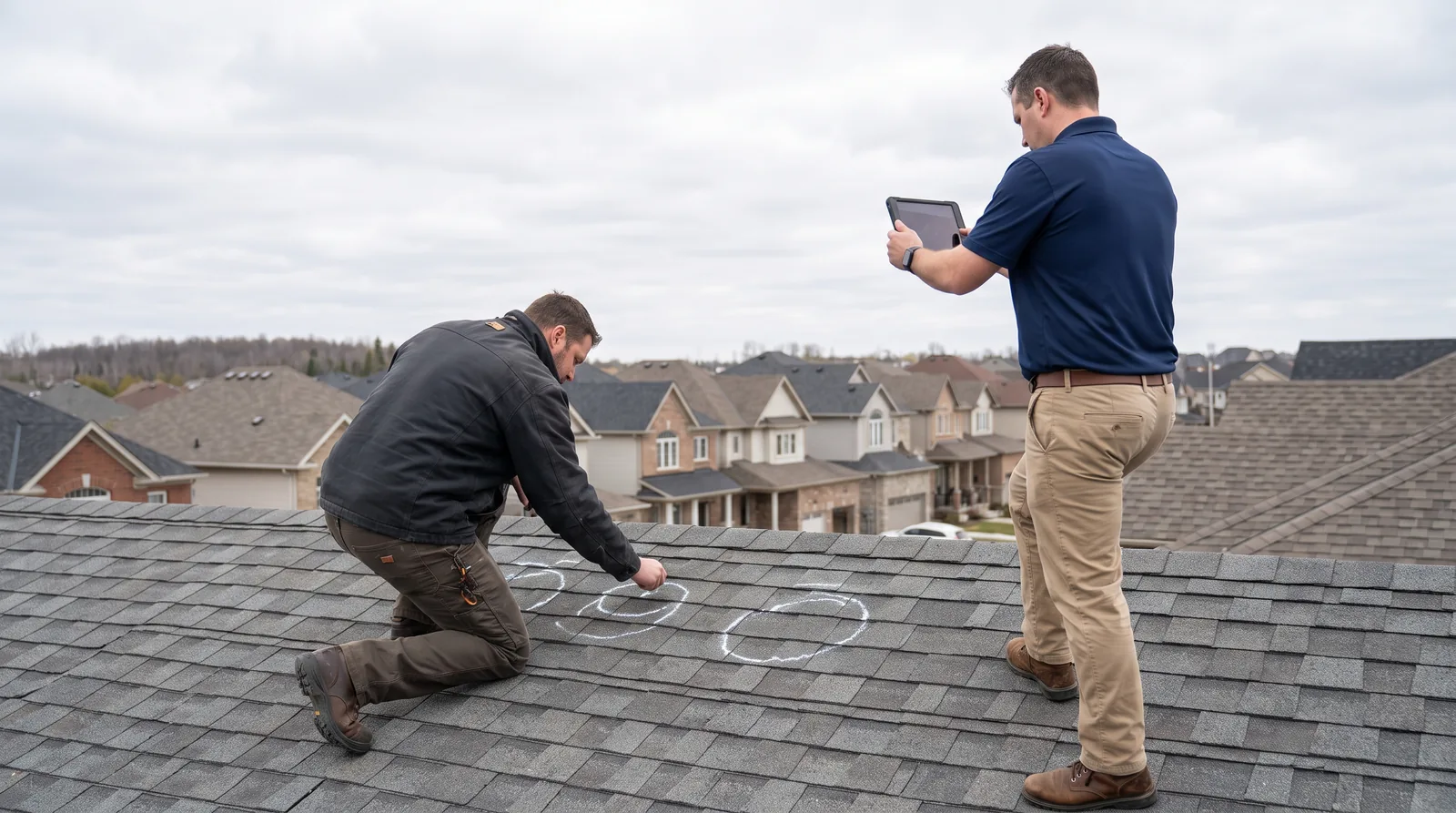
An insurance claim on a roof is mostly an argument about evidence. The homeowners who do well are the ones who had the damage documented properly before the adjuster arrived and who understood what their policy actually says. That is the part we can help with.
How the claim runs
- Free inspection first. We chalk test squares, photograph every hit with the date and slope, check soft metals and note the roof's age and layer count. You get a written report whether or not you file.
- You decide whether to file. Not us. If the damage is cosmetic or below your deductible we will say so — a denied claim still sits on your record.
- You call your carrier. The policyholder opens the claim. Give the date of loss, which we will have tied to a specific verified storm.
- We meet the adjuster on the roof. With the photographs and the chalk still there. The adjuster measures, scopes the damage and writes an estimate.
- We reconcile the scope. If the adjuster's estimate misses something real — a second layer, a steep-pitch charge, ice barrier the code requires, drip edge, valley metal, damaged decking — we submit it with documentation. Adjusters are working fast across hundreds of roofs and omissions are common. This is supplementing, and it is normal.
- The job gets built to the approved scope. You pay your deductible, the carrier pays the rest, and what we invoice matches what we installed.
Two things about your policy worth knowing before you call
ACV versus RCV. A replacement-cost policy pays what it costs to replace the roof today, usually in two parts: the depreciated value first, and the recoverable depreciation once the work is done and invoiced. An actual-cash-value policy pays the depreciated value and stops — on a fifteen-year-old roof that can be less than half the replacement cost. Many Kansas carriers have moved roofs onto ACV or onto a roof-payment schedule that steps down with age, and a lot of homeowners find out at claim time. Look for it in your declarations now, not after the storm.
Percentage wind-and-hail deductibles. Increasingly common in hail-prone Kansas counties. Instead of a flat $1,000, your wind-and-hail deductible may be 1 or 2 percent of the dwelling coverage — on a $400,000 home that is $4,000 to $8,000. It is a separate line from your all-other-perils deductible. Check which one you have before you assume a claim is worth filing.
What we are and are not
We are the roofing contractor. We document damage, provide estimates, meet adjusters and build the job. We do not adjust claims, negotiate settlements on your behalf or interpret your policy for you — in Kansas that is the work of a licensed public adjuster or your attorney, and anyone in a roofing shirt offering to do it is out of their lane. If your claim needs that kind of help we will tell you plainly and you can hire it.
Questions we get about this
Should I file a claim or just pay for the repair?
Compare the realistic repair cost against your deductible, and check which deductible applies - a percentage wind-and-hail deductible on a $400,000 Olathe home can be $4,000 or more. If the damage is a boot and a dozen shingles, paying for it is usually the better move. If hail has bruised whole slopes, that is what the policy exists for. We will give you the honest repair number so you can compare.
My claim was denied. Is that the end of it?
No. You can request a re-inspection, and if you disagree with the outcome most policies contain an appraisal clause - each side appoints an appraiser, and an umpire settles differences. You can also bring in a licensed public adjuster or an attorney. What helps most is independent dated documentation of the damage, which is exactly what our report is.
What is a supplement and why does my roofer keep saying it?
It is a request to add something the adjuster's original scope missed - a second layer found at tear-off, steep-pitch labour, code-required ice barrier or drip edge, rotted decking, valley metal. It is a routine and legitimate part of the process when it is documented. It becomes a problem only when it is used to inflate a job, which is why every supplement we submit comes with photographs.
Do you charge for the inspection or the adjuster meeting?
No. The inspection, the written report and meeting your adjuster on the roof are all free, and there is no obligation to use us for the work afterwards. We would rather be the company that gave you a straight answer.