Water runs downhill along the underside of the deck before it drops, so the brown ring on your ceiling is usually somewhere between two and fifteen feet from the hole that made it. That is the whole reason we start in the attic with a flashlight instead of on the roof with a caulk gun. Daylight through the deck, a rusted nail shank, a dark stain trailing down a rafter, wet insulation in one bay and dry in the next — these point at the actual entry, and none of them are visible from the ground.
What actually leaks on Olathe roofs
After enough of them, the list gets short and repeatable.
- Pipe boots. The number one leak in Johnson County, by a wide margin. The rubber collar around a plumbing vent dries out and splits after about twelve to fifteen Kansas summers — sooner on a south slope. A $40 part, a $300 repair, and a ruined ceiling if it waits.
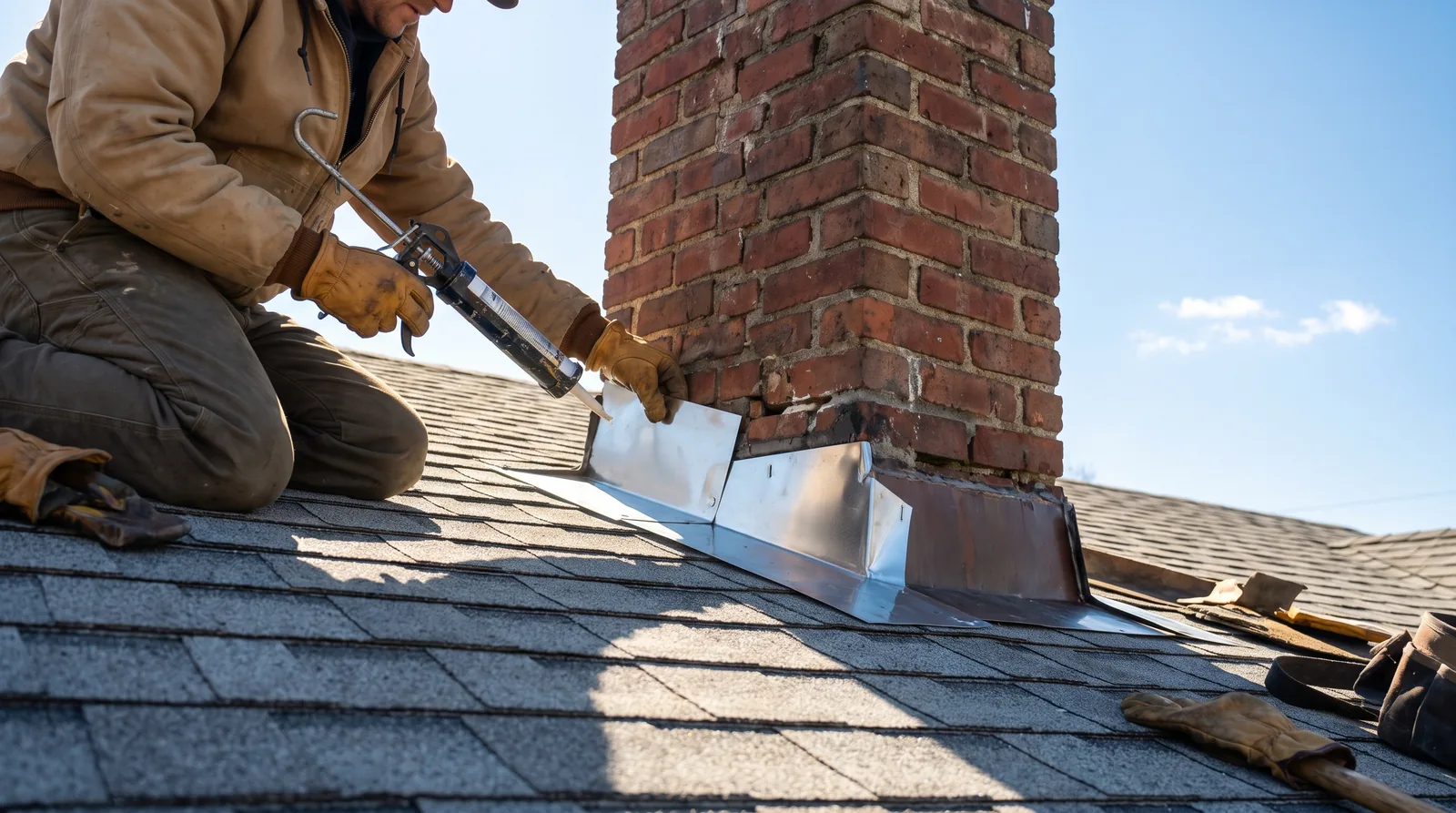
- Step flashing at a wall or chimney. Every one of those 1990s two-storys with a bump-out has step flashing woven between the shingle courses. If a previous roofer caulked over it instead of replacing it, the caulk is done in three years and the water goes behind the siding where you cannot see it.
- Valleys. The houses backing greenbelts fill their valleys with oak and sycamore litter, it holds water against the shingle, and the deck underneath softens. This is the failure we find most often on Cedar Creek and Stonebridge houses that back onto trees.
- Nail pops. Decking moves with the seasons and pushes nail heads up through the shingle above. Each one is a small hole directly through the roof.
- Ice-dam backup. A January melt-and-refreeze pushes water backwards up under the shingles at a north-facing eave. If the roof has no ice barrier — and most Olathe roofs built before the mid-2000s do not — it comes straight through. More on ice dams.
- Hail and wind you never knew about. A bruise from a two-inch stone does not leak the day it lands; it leaks two summers later when the mat finally cracks. If a storm has crossed your address, this is worth a separate look.
What a repair costs
Most single-point repairs in Olathe land between $350 and $900: a boot, a section of step flashing, a small valley rebuild, a dozen replaced shingles. Bigger jobs — rebuilding a chimney cricket, replacing sheets of soft decking, re-flashing a whole wall line — run $900 to $2,600. We give you the number in writing before we start, and if the honest answer is that the roof has three years left and a repair buys you those three years, that's what we'll say.
How we leave it
Photographs of the cause, the repair in progress, and the finished work, sent to you the same day. Colour-matched shingles where we can get them and an honest warning where we cannot — a fifteen-year-old roof has faded and a new bundle will not match it exactly. Everything we touch is nailed and sealed to manufacturer spec, not caulked.
Questions we get about this
Can you repair just one section, or do I have to do the whole roof?
One section, in most cases. Roofs fail at penetrations and transitions long before the field shingles wear out, and a boot or a length of step flashing is a genuine repair, not a stopgap. The exception is a roof that is failing everywhere at once — widespread granule loss, cupping, a second layer, or hail bruising on every slope. Patching one of those just moves the leak.
Will the new shingles match?
Close, rarely perfect. Asphalt fades in Kansas sun, and a bundle off today's pallet is a fresh colour even in the same product line. We keep the repair on a less visible slope where the roof allows it and tell you up front what it will look like. If matching matters more than cost — a house going on the market, for instance — we will price the slope instead of the patch.
Do I need a permit for a roof repair in Olathe?
No. The City of Olathe does not require a permit for reroofing or for repairs down to the deck on one- and two-family dwellings or townhomes, and no city inspection is scheduled for that work. The 2018 IRC requirements still apply to how it is built.
How fast can you get here?
Same day for an active leak, and any hour of the night for water actually coming into the house — we will tarp it immediately and do the real repair in daylight. Non-urgent repairs are usually within two to four days, longer in the two weeks after a big hail event when everyone in the county is calling at once.